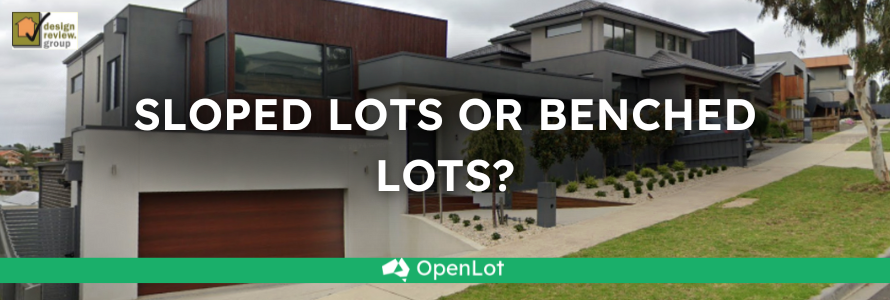

Benched lots with concrete sleeper retaining walls.
Do any lots on your estates have substantial slopes? Is it better to bench these lots, or let the lot buyers do the work? This bulletin discusses how houses can be built on sloping lots without the need for extensive site works and freestanding retaining walls.
For freestanding retaining walls, see our recent bulletin here.
Techniques to deal with slope will vary depending on a slope’s degree and direction. The response to a lot sloping up from the street is likely to be very different to a lot sloping down from the street. The response to a lot with a cross slope is likely to be different again. Some lots have both a significant longitudinal slope and a significant cross-slope.

This house uses drop edge beams to deal with the cross slope.
Dropped edge beams

A detailed section of a drop edge beam.
A dropped edge beam, also called a deepened edge beam, is a vertical concrete wall that meets the natural surface level, retaining fill underneath. This allows a house to be built on sloping ground rather than on a flat pad. Using dropped edge beams is cheaper in some instances than benching a lot and installing freestanding retaining walls.
Dropped edge beams tend to be used where the fall of the ground across the footprint of the building is less than 1.2 m. External stairs may be needed between the ground outside and the ground floor.

A house on a concrete slab with drop edge beams extending to the existing ground level.
Design standards to encourage drop-edge beams include:
“The house must minimise soil disturbance by taking advantage of the natural topography of the site.”
“Cut and fill must be less than 1.2 meters above or below natural ground level.”
Split levels

This house, on a lot with a steep cross-slope, has three floor levels.
A split level house has two or more staggered floor levels connected by short sets of stairs. This is usually done to better match the house to the slope of the ground around it. It is a useful technique where the lot has a significant cross-fall or longitudinal fall. Split levels may reduce or remove the need for freestanding retaining walls. The split levels minimize the difference between inside and outside, making movement between the two easier.
The example below shows a lot with a steep longitudinal slope. The house has been carefully designed to work with the slope. The rear of the house, on the left, is half a level different from the front of the house. Short sets of stairs connect the front, the back, and the different levels.


A split level house.
Design standards can require a maximum amount of excavation. On moderate slopes this encourages split levels.
“Excavation must be no more than 2m below the natural ground level.”
Why use dropped edge beams and split levels?
First home owners and volume builders are likely to want a flat lot. This both minimises site costs and avoids the uncertainty of what those costs might be. As the developer, you need to consider if the cost of adding retaining walls and benching the lots will be recouped in quicker sales and higher lot prices.
Benefits to building on sloped ground

Design Standards
Design standards that encourage split level designs can be included in an estate’s design code.
“Houses must respond to existing slopes and avoid excessive modifications to the natural ground levels.”
“Earthworks must be minimised. A split level house is preferred to cutting and filling the lot.”
"If the lot is steep, the house must minimise cut and fill, contain fill to within the footprint of the house, and provide easy access between the inside and the grounds. Techniques to achieve this may include drop edge beams and split levels.”
Minimising benching of lots reduces site costs to the estate developer, and can enhance profitability. Houses and the grounds around them are designed to the existing slopes reducing the need for freestanding retaining walls, which reduces site costs and contributes to a more attractive streetscape.